


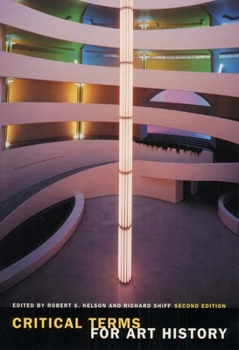
Critical Terms for Art History, Second Edition

Select Format
Select Condition 
Book Overview
Art has always been contested terrain, whether the object in question is a medieval tapestry or Duchamp's Fountain. But questions about the categories of art and art history acquired increased urgency during the 1970s, when new developments in critical theory and other intellectual projects dramatically transformed the discipline. The first edition of Critical Terms for Art History both mapped and contributed to those transformations, offering a spirited reassessment of the field's methods and terminology. Art history as a field has kept pace with debates over globalization and other social and political issues in recent years, making a second edition of this book not just timely, but crucial. Like its predecessor, this new edition consists of essays that cover a wide variety of loaded terms in the history of art, from sign to meaning, ritual to commodity. Each essay explains and comments on a single term, discussing the issues the term raises and putting the term into practice as an interpretive framework for a specific work of art. For example, Richard Shiff discusses Originality in Vija Celmins's To Fix the Image in Memory, a work made of eleven pairs of stones, each consisting of one original stone and one painted bronze replica. In addition to the twenty-two original essays, this edition includes nine new ones--performance, style, memory/monument, body, beauty, ugliness, identity, visual culture/visual studies, and social history of art--as well as new introductory material. All help expand the book's scope while retaining its central goal of stimulating discussion of theoretical issues in art history and making that discussion accessible to both beginning students and senior scholars. Contributors: Mark Antliff, Nina Athanassoglou-Kallmyer, Stephen Bann, Homi K. Bhabha, Suzanne Preston Blier, Michael Camille, David Carrier, Craig Clunas, Whitney Davis, Jas Elsner, Ivan Gaskell, Ann Gibson, Charles Harrison, James D. Herbert, Amelia Jones, Wolfgang Kemp, Joseph Leo Koerner, Patricia Leighten, Paul Mattick Jr., Richard Meyer, W. J. T. Mitchell, Robert S. Nelson, Margaret Olin, William Pietz, Alex Potts, Donald Preziosi, Lisbet Rausing, Richard Shiff, Terry Smith, Kristine Stiles, David Summers, Paul Wood, James E. Young
Format:Paperback
Language:English
ISBN:0226571688
ISBN13:9780226571683
Release Date:April 2003
Publisher:University of Chicago Press
Length:540 Pages
Weight:2.11 lbs.
Dimensions:1.3" x 6.6" x 9.3"
Customer Reviews
2 ratings
where art history and philosophy intersect,
Published by Thriftbooks.com User , 18 years ago
you will find books such as this one. A Ph.D. is not required to understand it, but it will give you an intellectual workout, as it is not a beginner's handbook. You need to have read some art history (beyond the "what, where, when, who" level), and some art criticism, to see the rationale behind its chapter headings. It is also not a book about works of art as such, but about the special terms and concepts used in current interpretive writing on the "fine" arts (primarily arts of Western European derivation, but the contributors are sensitive in handling the cultural bias of their sources). ALL of the authors are distinguished authorities on the topics they discuss. I think it is a strength of this book that they do not share a homogeneous intellectual background, or ideological bias, and also that they are not all the same age, but made their greatest contributions at different points in the recent (roughly, between 1970 and 1990) "crisis" of art historical writing. The most useful feature of this book, to my mind, is that it provides carefully argued contextual analysis of critical terms which either 1) have a long history of use (and therefore need unpacking before we can grasp the "unconscious"--sometimes contradictory--values they impose on the works to which they're applied), or 2) have been recently introduced to enable an informed critique of traditional art history. The cumulative effect of the various essays is to demistify some of our more cherished assumptions about the value of art: its timeless messages, its inspired origins, its spiritual uplift, its higher expressiveness/beauty/perfections. In other words, if you hope for a "feel-good" treatment of art critical standards, this is not your book. And yet, if you can accept that making and using works of art are social activities, and like the other products and customs of human societies, are constantly in flux even as they depend for their existence on inherited techniques, formulas, and ideals, then this book will provide a wonderful "relief map" of the intellectual foundations of current art history/art criticism.
Learning the rules of the game
Published by Thriftbooks.com User , 22 years ago
Most of these essays are written by extremely prominent art historians and critics, such as WJT Mitchell, Homi Bhaba, the late Michael Camille, Jas' Elsner, and Nina Kallmyer. Each writer explores a "charged" term currently used in art criticism, such as "representation," "social art history," "ugliness," and "beauty." In each essay, the writer explores the meaning of the term by applying it to a single work of art. Though the essays vary in difficulty, each is ultimately very rewarding. Highly recommended for anyone interested in the nuts and bolts of art criticism. An absolute must for journalists, art critics, and students.
Copyright © 2025 Thriftbooks.com
Terms of Use | Privacy Policy | Do Not Sell/Share My Personal Information | Cookie Policy | Cookie Preferences | Accessibility Statement
ThriftBooks ® and the ThriftBooks ® logo are registered trademarks of Thrift Books Global, LLC
ThriftBooks ® and the ThriftBooks ® logo are registered trademarks of Thrift Books Global, LLC
