


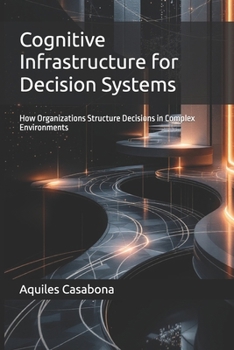
Cognitive Infrastructure for Decision Systems: How Organizations Structure Decisions in Complex Environments
No Customer Reviews

In complex commercial environments, performance is often pursued through better execution, increased automation, and more data. Yet, despite these advances, outcomes remain inconsistent. Why? Because the limitation is not execution.
It is how decisions are formed. This book introduces a structural perspective on artificial intelligence and organizational performance. Rather than treating AI as a tool for automation, it presents it as part of a cognitive infrastructure - a foundational layer that supports how decisions are made within complex, non-linear systems. Through the Cognitive Infrastructure for Decision Systems (CIDS) model, this work explores:
- Why experience alone is no longer sufficient in dynamic environments
- How fragmentation originates from decision structures, not just operations
- Why automation often amplifies misalignment instead of resolving it
- How organizations can structure decision-making as a continuous and adaptive process
- The evolving role of leadership as a designer of decision systems Instead of offering tactics or frameworks focused on execution, this book defines a decision architecture. A structure through which:
- data is interpreted within context
- assumptions are continuously validated
- and decisions evolve alongside the system itself The implications extend beyond commercial operations. They influence how organizations:
- learn
- align
- scale
- and operate under uncertainty This is not a book about doing more. It is about deciding better in environments where certainty no longer exists.
It is how decisions are formed. This book introduces a structural perspective on artificial intelligence and organizational performance. Rather than treating AI as a tool for automation, it presents it as part of a cognitive infrastructure - a foundational layer that supports how decisions are made within complex, non-linear systems. Through the Cognitive Infrastructure for Decision Systems (CIDS) model, this work explores:
- Why experience alone is no longer sufficient in dynamic environments
- How fragmentation originates from decision structures, not just operations
- Why automation often amplifies misalignment instead of resolving it
- How organizations can structure decision-making as a continuous and adaptive process
- The evolving role of leadership as a designer of decision systems Instead of offering tactics or frameworks focused on execution, this book defines a decision architecture. A structure through which:
- data is interpreted within context
- assumptions are continuously validated
- and decisions evolve alongside the system itself The implications extend beyond commercial operations. They influence how organizations:
- learn
- align
- scale
- and operate under uncertainty This is not a book about doing more. It is about deciding better in environments where certainty no longer exists.
Format:Paperback
Language:English
ISBN:B0GWTTXC5M
ISBN13:9798255734979
Release Date:April 2026
Publisher:Independently Published
Length:180 Pages
Weight:0.55 lbs.
Dimensions:0.4" x 6.0" x 9.0"
Customer Reviews
0 rating
Copyright © 2026 Thriftbooks.com
Terms of Use | Privacy Policy | Do Not Sell/Share My Personal Information | Cookie Policy | Cookie Preferences | Accessibility Statement
ThriftBooks ® and the ThriftBooks ® logo are registered trademarks of Thrift Books Global, LLC
ThriftBooks ® and the ThriftBooks ® logo are registered trademarks of Thrift Books Global, LLC
