


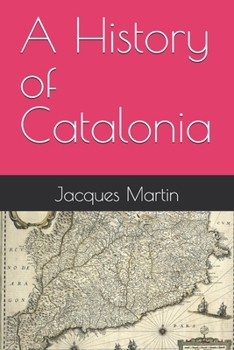
A History of Catalonia

From ancient Iberian settlements and Roman conquest to medieval kingdoms, maritime expansion, and modern political debates, A History of Catalonia offers a sweeping chronological account of one of Europe's most distinctive regions. Positioned between the Pyrenees and the Mediterranean, Catalonia emerges as a crossroads of cultures, armies, languages, and ideas-shaped by Greeks, Carthaginians, Romans, Visigoths, Moors, Franks, and the powerful institutions that grew from its frontier society.
The book traces the rise of the Catalan counties from the Carolingian borderlands, the growing power of Barcelona, and the eventual formation of the Crown of Aragon. It explores Catalonia's medieval golden age, when trade, naval strength, legal innovation, and Mediterranean ambition carried Catalan influence across the sea to places such as Sicily, Sardinia, and beyond. Along the way, it highlights the development of Catalonia's laws, language, institutions, and enduring tradition of negotiated self-government.
As the narrative moves into the early modern period, the book examines Catalonia's complicated place within the Spanish monarchy, including the Reapers' War, the War of the Spanish Succession, and the loss of historic liberties under the Nueva Planta Decrees. These turning points are presented as part of a larger story of centralization, resistance, adaptation, and the long memory of autonomy lost and pursued again.
The modern chapters follow Catalonia through industrialization, cultural revival, labor unrest, the Second Spanish Republic, the Spanish Civil War, Franco-era repression, and the restoration of democratic self-government. The book also addresses Catalonia's role in the European Union, its economic transformation, and the renewed independence movement that has made the region a subject of international attention in the 21st century.
Clear, accessible, and wide-ranging, this book is ideal for readers seeking a complete introduction to Catalonia's past and present. It combines political history with cultural, social, economic, and linguistic developments to show how Catalonia's identity was formed, challenged, suppressed, revived, and continually redefined across more than two thousand years.
Customer Reviews
ThriftBooks ® and the ThriftBooks ® logo are registered trademarks of Thrift Books Global, LLC
